

From Heroic Effort to System Architecture
Most leadership teams don’t struggle because they lack commitment or talent.
They struggle because they are still operating within a Hero-based system—one that quietly requires leaders to take on more responsibility, make more decisions, and absorb more risk as complexity increases.
The Power Flow Diagnostic is the cornerstone of the People-Powered Leadership Operating System (PPLOS). It helps leadership teams see—often for the first time—how much of their success depends on heroic effort rather than intentional system design.
This is not a personality assessment or a performance review.
It is a sense-making experience that reveals how leadership actually operates across four layers of the system: events, patterns, structures, and mental models.
By making the system visible, leaders can begin the shift from Hero—personally compensating for system gaps—to Architect—designing conditions where leadership capacity is shared and sustainable.
We reframe the challenge this way:
This is not a leadership capability problem. It’s a system designed for a simpler environment—now operating in far more complex conditions.
This insight marks the beginning of the Hero → Architect transition and sets the stage for PPLOS Lab 1, where leaders take up their role as architects of a new operating system.
Why It Matters
In Hero-based systems, leaders are rewarded for stepping in, fixing problems, and keeping things moving—often at great personal cost. Over time, this creates burnout, bottlenecks, and invisible dependency on a few individuals.
The Power Flow Diagnostic helps leaders see:
Where heroic effort is silently holding the system together
Where decisions, information, and authority are over-concentrated
Where the system unintentionally rewards control over collaboration
Where different design choices could make better behavior inevitable
Leaders to stop asking, “Why aren’t people stepping up?” and start asking, “What is the system asking people to do?”
That shift—from personal effort to system design—is the foundation of the PPLOS.
What We Measure
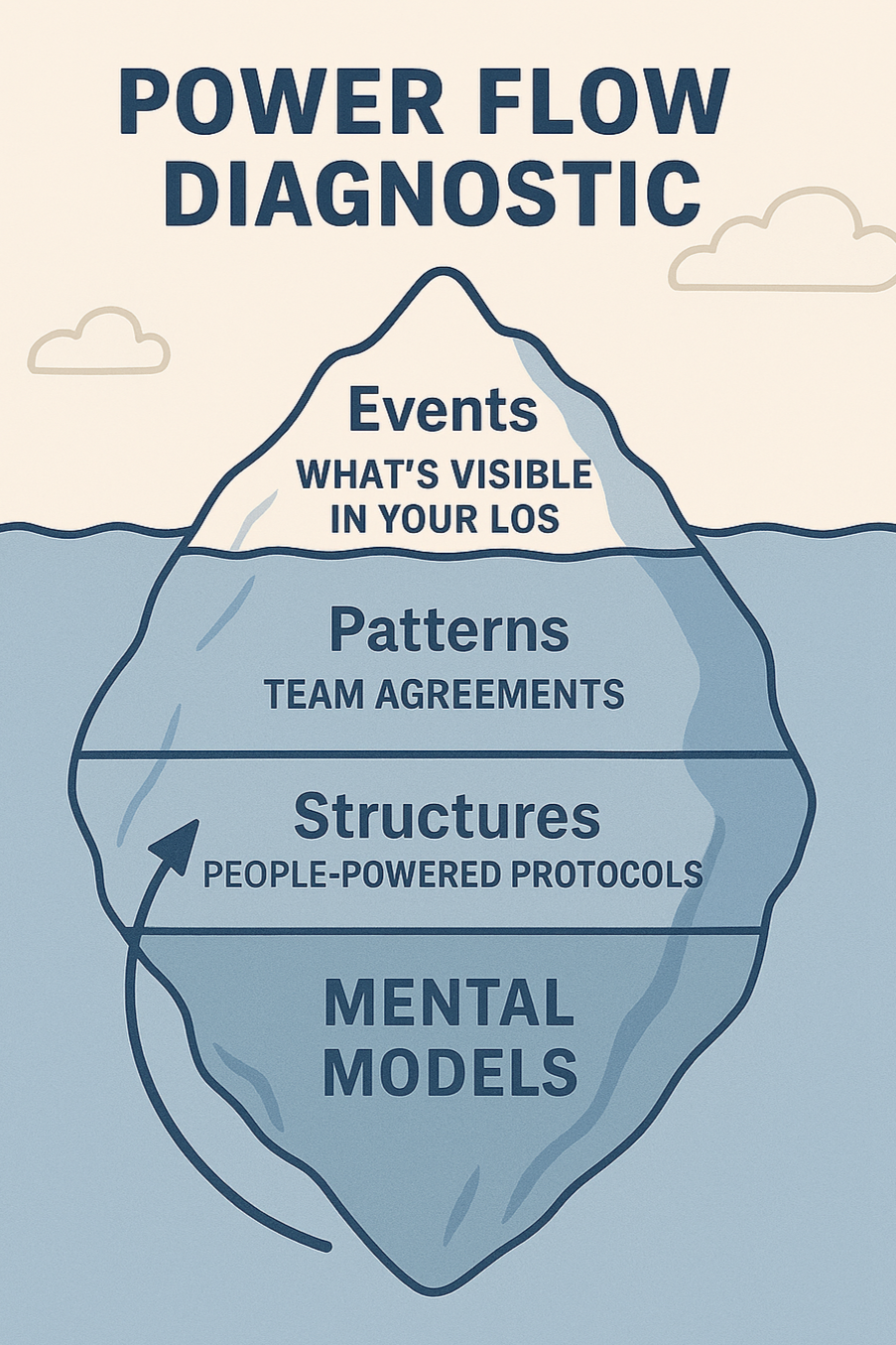
The diagnostic explores four layers of your leadership system, revealing where Heroics are required—and where Architecture is missing.
Events
Where heroics show up first
Are leaders constantly putting out fires?
Do decisions stall until a senior leader intervenes?
Does urgent work crowd out strategic focus?
These are often signs of leaders compensating for system gaps in real time.
Patterns
Where heroics become normalized
Do the same urgent issues repeat quarter after quarter?
Does information stay trapped in silos?
Do decisions consistently flow back to the same individuals?
Here, heroics stop being exceptional—and become expected.
Structures
Where the system quietly creates heroes
Are decision rights unclear or over-centralized?
Do approval paths slow work unnecessarily?
Is authority inherited by title rather than designed around expertise?
This layer reveals where leaders are forced to “mop the floor” rather than fix the pipes.
Mental Models
Where heroics feel necessary
“If I don’t step in, this will fail.”
“Challenging senior leaders isn’t safe.”
“Working harder is valued more than working smarter.”
These beliefs don’t come from weakness—they emerge when the system depends on heroes to function.
Each statement is rated on a 1–5 scale, with space for leaders to share context and stories. At the end, participants are invited to imagine redesigning one rule or process—beginning the shift from personal responsibility to shared architecture.
How It Works
Who participates: Leadership teams and key influencers
When: At the start of the PPLOS Installation journey
What you receive:
A visual map of your current Leadership Operating System
A clear picture of your organization’s Adaptive Gap
Insight into where Heroic leadership is compensating for the missing structure
A shared language for moving from Hero → Architect
We don’t diagnose people.
We diagnose the system.
The Power Flow Diagnostic creates a safe, blame-free way for leaders to see what the system is actually asking of them—and what it needs instead.
What Happens Next
After the diagnostic, we facilitate a guided reveal of your system’s story:
Events: “You told us you’re constantly firefighting.”
Patterns: “These same challenges repeat.”
Structures: “Authority and information flow are over-concentrated.”
Mental Models: “There’s a shared belief that leadership requires personal control.”
This is the moment leaders often realize:
We’ve been heroic—but we’ve also been trapped.
From here, leaders are ready to move into PPLOS Lab 1, where they begin redesigning the system so leadership no longer depends on heroics to succeed.
Ready to Move from Hero to Architect?
If you’re curious about how your leadership system really works—and what it would take to design one that doesn’t rely on heroic effort—we’d love to explore that with you.
Contact us to learn more about the Power Flow Diagnostic and how it can unlock clarity, flow, and collective leadership.
“Thank you so much for such an inspiring session. There is a lot to do for all. I think the key or a starting point is to LOVE people. The rest will go smoothly. Thank you all!”